Baby Things to Make Out of Military Uniforms
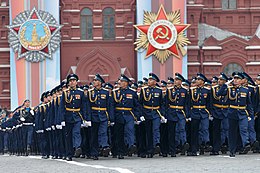
Total dress uniform, also known every bit a ceremonial apparel uniform or parade dress uniform, is the well-nigh formal blazon of uniforms used by military, police force, fire and other public uniformed services for official parades, ceremonies, and receptions, including individual ones such as marriages and funerals. Full dress uniforms typically include total-size orders and medals insignia. Styles tend to trace back to uniforms used during the 19th century, although the 20th century saw the adoption of mess dress-styled full-wearing apparel uniforms. Designs may depend on regiment or service branch (e.thou. army, navy, air force, marines). In Western dress codes, full dress compatible is a permitted supplementary alternative equivalent to the civilian white tie for evening wear or morning time dress for twenty-four hours wear – sometimes collectively called total dress – although military uniforms are the same for solar day and evening wear. As such, full dress uniform is the most formal uniform, followed by the mess dress uniform.
Although total dress uniforms are frequently brightly coloured and ornamented with gold epaulettes, braids, lanyards, lampasses, etc., most originated as practical uniforms that, with the adoption of fifty-fifty more applied uniforms, were relegated to ceremonial functions. Earlier World War I, most armed forces of the globe retained uniforms of this type that were usually more colourful and elaborate than the ordinary duty (known as undress), or the active service clothes uniform.[1]
While full dress uniform is predominantly worn at occasions by commissioned officers and non-commissioned officers, it may also be worn as an optional uniform by some senior enlisted personnel. It is as well sometimes worn by members of majestic courts, orders of chivalry or certain civilian uniformed services, although some of these may border to court uniforms.
Proper noun [edit]
The phrase "full dress uniform" is ofttimes applied in order to distinguish from semi-formal mess dress uniforms, besides as informal service apparel uniforms.
Yet, a full dress uniform is sometimes merely called a dress uniform. Although many services use the term dress generically for uniforms, allowing information technology to refer to more than mod service clothes ("combat") uniforms with suitable modifiers (e.g. the British Army's obsolete Boxing Dress; and the U.Due south. Army's obsolete Battle Wearing apparel Compatible). Therefore, the term dress compatible without prefix typically refers to full dress uniform every bit described in this article.
History [edit]
The British and United States armies were dependent upon voluntary recruiting and found that a smart dress served to attract recruits and improve morale amidst those already serving. The British regimental arrangement fostered numerous distinctions amongst different units.
All the same, this was not express to volunteer armies, with induct armies of continental Europe retaining many of the colourful features that had evolved during the nineteenth century, for reasons of national and unit of measurement pride. Thus, in 1913 most French soldiers wore cherry trousers and kepis every bit office of their total dress,[2] the majority of British foot regiments retained the scarlet tunics for parade and off duty ("walking out"),[iii] the German Army was characterised by Prussian blue,[4] the Russian past dark light-green,[5] and the Austro-Hungary Ground forces by a broad range of differing facing colours dating dorsum to the 18th century.[6]
In that location were usually exceptions to each of these rules, ofttimes distinguishing unique units. This included the German cuirassiers, who wore white full dress; British burglarize regiments, who wore rifle green; and French mountain troops who wore large berets and low-cal blueish trousers. The U.Due south. Regular army with its "dress blues" was an exception, with cavalry, artillery and infantry beingness distinguished only by the different branch colours.[7]
After Globe War I most full dress uniforms disappeared. Many of the regimes that had taken a item pride in the retention of colourful traditional uniforms had been overthrown and their republican, fascist, or communist successors had piddling incentive to retain old glories. Elsewhere cost and disillusion with the "peacock" aspects of old fashioned soldiering had a similar issue, except for ceremonial guard units and such limited exceptions as officers' evening or off-duty uniforms.[8]
Modern armies are characterised by simple and drably coloured apparel even for ceremonial occasion, with the exceptions noted above. However a full general trend towards replacing induct armies with long serving professionals has had, as a side effect, a reversion to dress uniforms that combine smartness with some traditional features. Thus the U.S. Army announced in 2006 that uniforms of modern cut but in the traditional nighttime and light bluish colours will get universal issue, replacing the previous grayness/green service clothes. The French Army has, with the abolition of conscription, reintroduced kepis, fringed epaulettes and sashes in traditional colours to article of clothing with camouflage "trellis" or light beige parade dress.[9] The British Army with its strong regimental traditions has retained a wide range of special features and clothes items to distinguish private units, in spite of recent amalgamations.[10] Although there still exist official patterns for total wearing apparel uniforms for each regiment or corps inside the British Army, this uniform is seldom issued at public expense, except for units which are often on public duties, such equally the Guards Partitioning, Regimental Bands and Corps of Drums, which are bought from the Regiment's allowance.[11]
Full wearing apparel uniform by country [edit]
Argentina [edit]
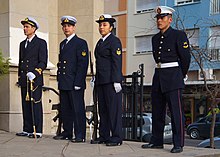
In the Armed Forces of the Argentine Republic, the Argentine Federal Police, Argentine National Gendarmerie and Naval Prefecture, apparel uniforms are worn during military machine and civil occasions, especially for the military bands and colour guards. They are a reminder of the military and law enforcement history of Argentine republic, especially during the early on years of nationhood and the wars of independence that the state was a part.
The Argentine Regular army'south full apparel compatible is greenish with a visor cap, epaulettes, sword set and scabbard (for officers), long green pants, a black belt, and black shoes or boots. However, several regiments within the Argentine Army are authorized total clothes uniforms, which originate from the 19th century, including the Regiment of Patricians, the Regiment of Mounted Grenadiers, and the 1st Artillery Regiment in the Buenos Aires Garrison.
The Argentine Navy dress uniform is a navy bluish rig with a visor cap for officers and senior ratings and sailor caps for junior ratings, epaulettes and sleeve rank marks (for all offers), a sword ready and scabbard for officers, blue long pants (skirts for female person personnel), a chugalug and black leather shoes or boots. Marines vesture peaked caps with the apparel uniform. Epaulettes are but worn with the dress uniform.
For the Argentine Air Strength, a like uniform to one used by the Royal Air Forcefulness in the Britain, however the used the colour used is much brighter.
Regardless of service branch military police personnel wear helmets with their dress uniforms, plus armbands to identify service branch.
Australia [edit]

The Australian Ground forces has several orders of ceremonial uniforms.[12] The Imperial Australian Navy also accept a few unlike formalism dress uniforms for its commissioned officers, senior sailors, and junior sailors.[13] Members of the Australian military machine wear these uniforms for formalism occasions, commemorative events and special occasions.[14]
Canada [edit]
Canadian War machine [edit]

The Canadian Army's universal full dress uniforms includes a red tunic, midnight blue trousers with a cerise trouser stripe, and a Wolseley helmet.[15] [16] However, some regiments in the Canadian Army maintain authorized regimental differences from the Army's universal full dress, including several armoured units, Canadian-Scottish regiments, foot guards, and Voltigeur/rifle regiments.
Full clothes uniforms for the Regal Canadian Air Strength (RCAF) consists of a blue plumage, where the headdress allows, an air strength light blue tunic, trousers and facings.[fifteen] The RCAF pipe band's total dress uniform is modelled after the uniforms used past Scottish Highland regiments. It includes a feather bonnet; air force blue doublet, facings, and pipings; RCAF tartan kilt; and blueish garters. The full dress uniform for the Regal Canadian Navy includes a dark navy blue tunic, trousers, and white facings.[fifteen] However, full apparel in the Royal Canadian Navy is no longer issued.
Regulations for the wear of full dress are contained in the Canadian Forces publication Canadian Forces Dress Instructions, nether No. 1B Ceremonial Dress.[17] Amendments to dress regulations are issued through the role of the Vice Primary of the Defence Staff (VCDS), initially in the form of a CANFORGEN (Canadian Forces General) message, which is placed in the dress manual until an official publication subpoena tin be promulgated.
Wearing apparel regulations may also be amplified, interpreted, or amended by the commanders of formations and units (depending on the commander's authorisation) through the issuing of Standing Orders (SOs), Ship's Standing Orders (SSO), Routine Orders (ROs), and Standard Operating Procedures (SOPs). This may include distension where the regulations are unclear or are not mandatory; amendments or reversal of some existing regulations for special occasions or events; or the promulgation of regulations regarding the wear of traditional regimental manufactures (such as kilts).
Purple Military College of Canada [edit]
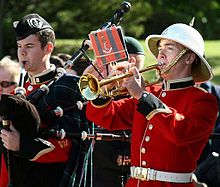
The total dress uniform for an officer cadet of the Royal Military College of Canada is like to the universal full dress uniform of the Canadian Army, with pocket-sized variation.[xvi] The full apparel uniform used by the Majestic Military College has remained essentially the same since the establishment'due south founding in 1876, although the pillbox hat has replaced the shako. The pith helmet remains in use for ceremonial parade positions only.
Non-military organisations [edit]
Canadian Buck Organisations [edit]
The youth cadet programs in Canada, the Royal Canadian Army Cadets, Purple Canadian Body of water Cadets and the Royal Canadian Air Cadets each maintain their own apparel uniforms. Youth-based Canadian cadet organisations are sponsored by the Canadian Military, with uniforms provided gratis of charge and funded by the Section of National Defence. Full apparel uniforms worn by cadets are modeled after the organization's sponsoring service branch.
Majestic Canadian Mounted Police [edit]
The modern apparel uniform of the Royal Canadian Mounted Police is closely based on the everyday uniforms used by the predecessor Northward-West Mounted Police in the late nineteenth century. It features the Reddish Serge, a scarlet British-mode military pattern tunic, complete with a high-cervix collar and dark blue breeches with xanthous stripes derived from British and Canadian cavalry uniforms of the aforementioned era, and usually a entrada hat (or "stetson") and brown riding boots.
Republic of chile [edit]
Chilean Air Force [edit]
The full dress uniform of the Chilean Air Force since 2001 has been a medium-blue tunic and trousers, worn with a peaked visor cap. For parade dress, officers additionally article of clothing a sword belt.
Chilean Army [edit]

Though full dress uniform in the Chilean Army typically is feldgrau, some units wear more colorful uniforms; here, a ceremonial cavalry unit wears a dress uniform based on an early twentieth-century uniform of High german dragoons.
The usual total dress uniform of the Chilean Regular army is based on twentieth-century German feldgrau uniforms; still, several units wear more colorful full apparel uniforms. Cadets of the military university "Bernardo O'Higgins Riquelme" wear a Prussian blueish uniform with Pickelhaube, based on the uniform worn by the Wilhelmine foot baby-sit regiments. Some military units, including the Chacabuco and Rancagua regiments, vesture a compatible from the War of the Pacific during parades, with kepis as headdress. The Buin regiment (2nd Army division in the Santiago Metropolitan region) has reintroduced the infantry regimental uniform of the Chilean War of Independence, having been formed in December 1810 as the 1st Infantry Regiment "Chilean Grenadiers", the original unit of the Chilean Army. The 1st Cavalry Regiment and the Krupp Artillery Battery of the 1st Artillery Regiment, both ceremonial units of the Army, take since 2012 worn the early on twentieth-century Prussian-style full dress uniforms of the Regular army's cavalry and artillery branches.
[edit]
The Chilean naval officeholder's clothes uniform is navy-blue with a peaked hat, sword strap (for petty officers, color escorts and cadets, just during parades and ceremonies), navy-bluish trousers, and blackness boots. The enlisted uniform (for sailors) evinces a mix of Prussian and British influences, having a sailor cap with the dress) while the Marine enlisted and NCO uniform is a dark-blue naval rig with trousers and a chugalug plus a peaked cap.
The clothes uniform of the naval academy "Arturo Prat" is also blue with trousers, but with headdress similar to that worn by Prat and the crew of the Esmeralda during the Battle of Iquique in 1879. The headdress worn is the peaked cap.
France [edit]
Equally with many European countries, the French military used in the 19th and early 20th centuries many traditional and heavily decorated apparel uniforms. Since World War Ii, they are not in common apply and usually restricted to special units in the French Army and National Gendarmerie.
French Army [edit]

In the Army, simply bands and schools take a complete full clothes (grande tenue) uniform. Units of the Chasseurs Alpins, French Foreign Legion, Troupes de Marine, 1st Spahi Regiment and Tirailleurs are permitted to wear, on special circumstances such equally military parades, a variant of the service or combat uniform which includes items of historic ceremonial clothes such equally headresses, fringed epaulettes, cloaks, waist sashes etc. This is called "Tradition Uniform".[18]
The Air Force and the Navy do non outcome apparel uniforms, but on special ceremonies, such equally changes of control, military machine personnel should add together swords or daggers and full medals to their service uniform.[19] [20] Bands of the French Army are permitted to wear special compatible depending on circumstances. On representation duty, they often use a 19th c.-style wearing apparel uniform.
Armed services schools [edit]
Armed forces schools of the French Army, including école spéciale militaire de Saint-Cyr, école militaire interarmes and école nationale des sous-officiers d'active, utilize total dress uniforms dating back to the 19th century worn by both students and staff.
In addition to the military machine schools, École Polytechnique also maintains 19th century military machine-styled full dress uniforms. Founded as a military academy, the institution was transformed into a state-sponsored civilian post-secondary school in 1970, although all the same operated past the French Ministry of Defence.
National Gendarmerie [edit]

The Republican Guard of the National Gendarmerie is the last unit to wear wearing apparel uniform as service compatible, as baby-sit of honour detachments are required to wear it while on duty. The cavalry regiment habiliment a 19th-century dragoon uniform, with metal helmet and white riding trousers, while the infantry regiments use a loftier-collared traditional gendarmerie uniform. The officer cadets and the staff of école des officiers de la gendarmerie nationale besides use uniforms whose styling dates dorsum to the 19th century.
Indonesia [edit]

The Indonesian National Armed Forces, Indonesian National Police, and other uniformed institutions of the country have their own types of Apparel uniforms known as "PDU", an abbreviation from Pakaian Dinas Upacara literally meaning "ceremonial uniform" in Indonesian; worn during formal occasions and when attending ceremonies. The Dress uniform (PDU) of the National Armed Forces consists of several categories which are:
- PDU I - (Service medals and brevets attached)
- PDU IA - (Society decorations attached and honorary sash worn over for those who are entitled to wear information technology)
- PDU II - (Mess dress compatible)
- PDU IIA - (Mess wearing apparel compatible with social club decorations attached)
- PDU III - (Service ribbons attached)
- PDU IV - (Short sleeved, with no necktie worn).[21]
Each uniform category is worn for different purposes and for sure occasions. The "PDU I" and "PDU IA" are regarded as "full clothes uniforms" which are worn for formal state occasions and when attention formalism events of loftier significance. The headdress worn for this uniform is a peaked cap for men and a crusher cap for women, and for officers from special forces, as well as the Military Police, may wear their respective berets. When wearing the Mess dress uniform, no headdress is worn.
The "PDU Iii" compatible is worn during receptions and/or during the welcoming ceremony of a visiting high ranking foreign invitee (head of country or caput of government). While the "PDU Iv" uniform is worn for occasions such every bit: Alter of Command ceremonies, attending a passing out parade, and worn by war machine judges in the court.[22] The mess dress uniform is basically the same for the iii branches of the armed forces. For male Indonesian Navy officers wearing the full apparel compatible ("PDUs" I and IA), will always carry his clothes sabre wherever he goes, female personnel and officers in the other paw would carry her issued dress uniform pocketbook except for those in command posts which are also entitled to sabres. Enlisted ratings of the Indonesian Navy (except those in the Marine Corps and Denjaka, which wears the purple beret and special forces operators of KOPASKA that clothing the maroon beret) article of clothing The states dixie caps with the full wearing apparel.
State of israel [edit]
Each arm of the Israeli Defense force Force (IDF) ground forces, Navy and Air Strength has its ain dress uniform, with split versions for summer and winter. These are similar in style to civilian business organization dress suits, or to the service dress uniforms worn by the British forces. The dress uniform includes a blazer-type jacket, worn with a white shirt, and a tie. The basis forces compatible is dark green, with a single-breasted, three-buttoned jacket and tie of the aforementioned colour. Headgear worn is the beret. The air force compatible is of the same design, merely medium blue. The naval uniform has a darker blue, double-breasted, vi-buttoned jacket, with gilded-coloured rank insignia on the cuffs.[23]
In 2016, the IDF Main of General Staff Gadi Eizenkot announced that all officers ranked Tat Aluf (brigadier general) as well as certain lower ranked officers would wear the Madei Srad clothes uniforms in official ceremonies on Yom HaShoah, Yom Hazikaron and Yom Ha'atzmaut.[24] Considering of the small-scale number of uniforms required they are tailor made for the specific officer. Prior to 2016, the wearing apparel uniform, the Madei Srad was but worn abroad, either by a military attaché or by senior officers on official land visits.
Russia [edit]

The uniforms of the Russian War machine were inherited from the Soviet Armed Forces and modified throughout the years. Some features of mod full dress compatible worn past both ground forces and navy personnel date from those of the final Czarist flow, prior to 1917. Most notably these include the blue-green shade of the mod regular army officeholder's parade and walking out uniform; the nighttime blue and white dress uniform still worn past sailors; and the ceremonial dress of the Kremlin Regiment.
Sweden [edit]
Various forms of total dress uniforms were used by all regiments of the Swedish Armed forces for ceremonial purposes until the 1960s, when they were generally discontinued, with the exception of the Svea Life Guards and the Life Guard Dragoons yet retaining colourful full apparel uniforms of 19th century origin for ceremonial use. The remaining parts of the branches tend to apply a variant of the mess dress uniform chosen "full mess uniform" for formal article of clothing purposes. White spats and belts may also be added to their service dress uniforms for parades or certain ceremonial purposes.
Swedish Army [edit]
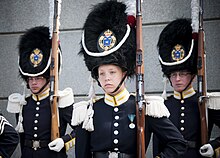
There are three versions of full dress uniforms in use in the Swedish Regular army every bit of the present twenty-four hour period, all belonging to the Life Guards. The infantry wears the dark blue compatible of the Svea Life Guards (1st Life Guards) with yellowish neckband, cuffs and pipage which dates dorsum to 1886. The Swedish Army Band wears the uniform of Göta Life Guards (2nd Life Guards), with red collar, cuffs and piping. The headdress of the infantry is mainly the pickelhaube typed helmet in black leather from 1887. On state ceremonies, a white buffalo pilus plume is added. Bearskin hats dating from 1823 are still in employ on special occasions.
The cavalry, including the Swedish Cavalry Band, wear the royal blue uniform of the Life Guard Dragoons (1st Cavalry) from 1895. Officers have a somewhat lighter colour on their full wearing apparel uniform compared to the troopers. The pickelhaube type helmet is made of nickel-plated steel with brass details and dates back to 1879. Changes were made in 1900 which transformed the helmet into a cuirassier style helmet. In 1928 with the affiliation of the 1st and second Cavalry Regiments, a captain wreath was added, together with a golden laurel wreath. Officers' golden chin straps with panthera leo "mascarons" from the Life Regiment Dragoons (second Cavalry) were also authorised for the new blended regiment. On mod state occasions officers habiliment white buffalo hair plume while troopers wear a horse hair plumes of the same color.
[edit]

Two officers in full wearing apparel on the royal barge Vasaorden. In the Swedish Navy, full dress is restricted to naval officers serving on the Vasaorden
In the Swedish Navy, merely ane ceremonial uniform is still in employ. It is restricted to naval officers serving on the royal barge "Vasaorden" (Order of Vasa); a ship used just on rare formalism occasions. The uniform dates back to 1878.
Uk [edit]
British Army [edit]
Almost of the various uniforms worn by the British Army today originate in old gainsay uniforms. At the start of the 19th century, British Regular army Regiments of Foot, trained to fight in the manner dictated by a weapon (the musket) which demanded close proximity to the target, were non concerned with cover-up, and wore red coats (scarlet for officers and sergeants). Burglarize regiments, fighting as skirmishers, and equipped with rifles, were more than concerned with concealment notwithstanding, and wore dark greenish uniforms. Light Infantry regiments were also trained equally skirmishers but wore cherry uniforms with green shakos. Whereas the infantry generally wore polished contumely buttons and white conveying equipment, the Rifles wore blackness.

Infantry uniforms of the British Army, from 1750–1835. Total clothes uniforms in the British Regular army originate from former combat uniforms.
Prior to the outbreak of Earth State of war I full apparel uniforms were universal issue for all regiments of the British Ground forces when on "home service" in Britain itself. Line infantry and Foot Guards, dragoons, Life Guards and Royal Engineers all wore cherry-red tunics.[25] The Royal Regiment of Artillery, hussars, all simply ane lancer regiment, and all back up corps wore dark blue uniforms. Just Rifle regiments wore green. Total dress varied profoundly in detail, according to the arm of service or in many cases the individual regiment.[ citation needed ]. Reserve units were for the well-nigh office distinguished by having silver (rather than gold-coloured) lace, buttons and accoutrements in full dress. From the Crimean State of war on, a narrow red stripe (piping) down the outside of each trouser leg was common to all red coated infantry units. Cavalry however wore stripes of regimental color (white, yellow, bluish/grey etc.) on their riding breeches. Scottish Highland regiments did not wearable trousers, favouring the kilt, and Scottish Lowland regiments adopted tartan trews. All Scottish regiments wore doublets of distinctive cutting instead of the tunics of English, Irish and Welsh units.
Full dress headwear varied (both from regiment to regiment, and over time as influenced by military fashion): bearskins were worn by the Foot Guards, the second Dragoons (Royal Scots Greys) and (in a unlike form) by Fusiliers. Plumed helmets were worn by the Dragoons (except 2nd), Dragoon Guards and the Household Cavalry. Hussars wore their distinctive busby, which as well came to be adopted by the Royal Artillery, the Royal Engineers and certain other Corps; information technology was likewise worn in a different form by Rifle regiments. The Lancers had their chapka. Infantry of the line frequently wore shakos (afterward supplanted by the 'dwelling house service helmet'), as did others; though Scots and Irish gaelic regiments tended to have their ain distinctive full-wearing apparel headwear. General officers and staff officers ordinarily wore plumed artsy hats in full dress, as did regimental staff officers and those of some support services. In hotter climates, for all of the above, a white pith helmet was often substituted.
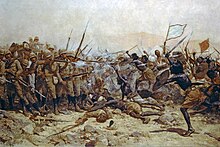
The rising of rifles and smokeless powder led to the adoption of khaki uniforms in the field, with blue, scarlet, and burglarize green tunics relegated to ceremonial/parade utilise.
Get-go with the Second Anglo-Afghan State of war of 1878, the British Ground forces began adopting light khaki uniforms for Tropical service that was first introduced in 1848 with the Corps of Guides in India.[26] This innovation arose from experience fighting irregular forces in India, for example on the Indian North-W Frontier and during the Indian Mutiny, and in Africa during the Anglo-Zulu State of war, too as the invention of smokeless gunpowder and the increasing effectiveness and usage of rifles. In 1902 a darker shade of Service Dress (SD) was adopted for field and ordinary utilise in United kingdom of great britain and northern ireland itself. The scarlet, bluish and rifle dark-green uniforms were retained for article of clothing as full clothes on parade and "walking-out dress" when off duty and out of barracks. As worn betwixt 1902 and 1914 by all non-commissioned ranks, walking-out dress was essentially the same as review order, except that a peaked cap or glengarry was worn instead of the full dress headdress and overalls (strapped trousers) were substituted for cavalry breeches.[27]
When khaki web carrying equipment was introduced, the before, white or black leather carrying equipment was retained for wearable with the wearing apparel uniform. Equally with the earlier uniforms, the officers' uniforms differed in quality and detail from those worn by the Other Ranks. Officers purchased their own dress uniforms from regimentally approved tailors while other ranks were issued all orders of wearing apparel from authorities stocks.
With the outbreak of Globe War I in Baronial 1914 all full dress and other coloured uniforms ceased to be worn by the British Army. After 1919 they were restored to the Household Cavalry and Foot Baby-sit for ceremonial purposes but not to the majority of the army. Officers were authorised to wear full dress for certain special occasions such equally Courtroom levees (formal presentations to the Monarch) and it was customary to wear these uniforms at social functions such equally weddings. By 1928 bands were wearing full apparel on occasions where they were not parading with the remainder of the regiment (who had only khaki service apparel). The pre-1914 dress uniforms were notwithstanding held in store and occasionally reappeared for celebrated displays. However, there was no serious attempt to make them general upshot over again, primarily for reasons of expense. When (khaki) Battle Dress (BD) uniforms, which had a short blouse instead of a tunic, were adopted immediately before the Second Earth State of war, the older khaki Service Apparel became a smart compatible for clothing on the streets, and on moderately formal occasions.
Later on World War 2 the coloured, full clothes uniforms were once again reintroduced for ceremonial occasions by the Brigade of Guards and to a express extent by regimental bands. Officers (and later senior non-commissioned officers) resumed wearing mess uniforms in traditional colours from most 1956 on. These are nonetheless worn, although regimental amalgamations have led to numerous changes from the pre-war models.
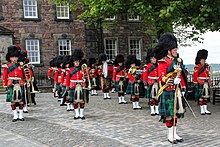
With express exceptions, the unique regimental full wearing apparel uniforms finally disappeared after 1939; today they are only by and large worn, on ceremonial occasions, past the Bands and Corps of Drums, by certain representatives on parade (east.g. some regimental Pioneers, or those forming a guard of honour) and by the regiments of the Household Division. In almost regiments they were replaced past a generic nighttime blue uniform known as No 1 Dress. This dated back to obviously "patrol" uniforms worn past officers before 1914 every bit an informal "undress" uniform. An early version had been worn by some units in the 1937 coronation of King George Vi and Queen Elizabeth but had not been made general issue at the time. In the form adopted after World War Two, most regiments were distinguished but past coloured piping on the shoulder straps, coloured lid bands, buttons and badges. Still Scottish regiments retained their kilts or trews as well as the distinctive doublets (in "piper greenish" or dark blue) of the one-time scarlet uniform.
Rifles regiments had night green uniforms and cavalry retained a number of special features such as the crimson trousers of the 11th Hussars or the quartered caps of lancer regiments. A white, lightweight tunic (No 3 Wearing apparel) was also authorised for apply in the tropics, or during the summer months in warmer temperate climates (such as Bermuda). The blue "home service" helmets were not worn equally office of the No 1 wearing apparel uniform, except by members of some bands or corps of drums which retained their old full wearing apparel uniforms, at regimental expense. English Rifle regiments were amalgamated into the Majestic Greenish Jackets, which continued to wear a dark dark-green dress uniform, and black buttons and belts. Contempo changes accept brought the Royal Green Jackets and The Calorie-free Infantry together into a single regiment The Rifles, which continues to habiliment nighttime dark-green.

The Waterloo Band of The Rifles in full dress. The Rifles keep to use rifle green in their full dress uniform.
Berets were introduced initially into the Royal Tank Corps in the Offset World State of war and their apply became more than widespread in the British Regular army during and afterward the Second World War to supersede side caps for habiliment with combat uniforms when protective headgear was not existence worn. Originally, khaki was the standard colour for all units, just specialist units adopted coloured berets to distinguish themselves. For example, airborne forces adopted a maroon. This has since been adopted by many other parachute units around the world. The Commandos adopted a green beret. The Special Air Service (SAS) initially adopted a white beret quickly changing this to a beige or sand coloured one. From 1944 they wore the Maroon airborne forces beret only the beige beret was re-adopted post-obit the re-formation of the Regular SAS in Malaya. Khaki was replaced every bit a generic colour for berets later on the state of war by dark blue, and this is the colour worn past those units non authorised to use a distinctively coloured beret.
A peaked cap, with a coloured hat band, is intended to be worn with the No 1 Clothes uniform, berets are the nearly mutual form of headdress seen with other orders of clothes and are worn in No1 and two wearing apparel by some Regiments and Corps.
The blueish or green No 1 Wearing apparel was never universally adopted after its initial introduction in 1947. The reason was mainly one of economic system, although information technology was sometimes criticised equally being as well similar to police and other civilian uniforms – lacking the immediately recognisable military status of both blood-red and khaki. Khaki No 2 dress being the most usual order of dress for parades and formal occasions.

Equally noted above, the practise of issuing other ranks in line regiments with total sets of both service dress and clothes uniforms finer ended in 1914 and was never completely returned to. Today, with the exceptions noted to a higher place, full dress or No 1 Dress uniforms are only held in limited quantities as common stock, and issued but to detachments on occasional special ceremonial occasions. Practices do however vary between units and historic items of compatible are more likely to appear where tradition is particularly strong. Every bit an example, the Royal Military Academy Sandhurst wore scarlet and blueish "review society" uniforms until World War I, substituted khaki service dress for parade from 1919 to 1939 and now holds night blue No 1 dress uniforms for the use of its cadets. The Purple Military Police retain the latter order of dress for general consequence[ commendation needed ].
Majestic Air Force [edit]

Historically, the Regal Air Force regulations permitted the wearing of a full dress compatible in both home and warm-weather variants. Although the home wear version of full wearing apparel is no longer worn (except in a modified grade by RAF bandsmen),[28] the tropical total formalism dress continues to be authorised.
The temperate full wearing apparel compatible was introduced in April 1920. Information technology consisted of a single-breasted jacket in blue-grey with a stand up-up collar. Rank was indicated in gold braid on the lower sleeve and white gloves were worn. As with the British Army later 1914, full dress was not full general issue during the inter-State of war menstruation, but was authorized for article of clothing by specific categories such every bit bandsmen and commissioned officers. The latter more often than not wore full wearing apparel only for infrequent occasions such as attendance at court levees and social functions such as weddings. Military attaches and royal aides de camp were amongst the few serving officers who might have regular occasions to wear full dress.
Initially the full dress uniform was worn with the service clothes cap. Even so, in 1921 a new form of head-dress was introduced. It was designed to resemble the original flying helmet and it consisted of a leather skull cap trimmed with blackness rabbit fur. The helmet also featured an ostrich feather plume which was connected to an RAF badge. This helmet was never popular and inferior officers were eventually permitted to wearable the service dress lid on full clothes occasions.
Group Helm the Duke of York (later Rex George Vi) wore RAF full dress at his hymeneals to Lady Elizabeth Bowes-Lyon in 1923. The Duke wore or carried the total dress headgear rather than the service apparel cap.
[edit]

Vice Admiral Philip Watson in formalism day dress. Introduced in 1960, ceremonial day dress is a variant of the Royal Navy's total dress uniform that was taken out of service in 1956.
Since the mid-eighteenth century, when naval uniforms were introduced, flag officers had different full-dress and undress versions, the latter being worn from twenty-four hour period to day, the former merely for formal occasions. By the late nineteenth century, an officer'south full dress compatible consisted of a navy double-breasted tailcoat with white facings edged in gilt (on the collar and cuff-slashes), gold lace (indicating rank) on the cuffs, epaulettes, sword and sword-belt, worn with golden-laced trousers (except for sublieutenants and warrant officers) and a cocked hat. This order of uniform lasted through the kickoff one-half of the twentieth century, existence placed 'in abeyance' at the onset of the Second Earth War, and was worn by Prince Philip at the Coronation of Elizabeth Ii. In 1960, full clothes compatible was reintroduced in the course of Ceremonial Day Apparel. Worn merely by express categories of senior officers this is very similar to the one-time full dress, but without fringed epaulettes or cuff slashes, and worn with a peaked cap.
In tropical climates, a single-breasted white tunic, with ii patch pockets, 5 buttons downwardly the front, worn with the peaked cap, white trousers, white shoes, shoulderboards and sword and sword belt is worn by commissioned officers. Before 1939, this was worn with a white tropical helmet; abolished in 1949, for full clothes purposes. Since 1995 this is only regularly issued to officers of the rank of captain and above, all other officers existence issued a white bush jacket, but are issued this uniform from stores if ordered to past command.
There is likewise a version for wear past warrant officers and senior ratings (i.east. Chief Petty Officers and Piddling Officers), it is similar to that worn past commissioned officers and is worn with the same cap, trousers and shoes, merely the tunic has but iv buttons down the front, substantive rate badges, and no shoulderboards. When armed with rifle, this is worn with anklets and white web belt and blackness boots. This is just worn on extremely formal occasions, ordinarily by guards of honour, at the society of command. Warrant officers kickoff course habiliment the appropriate sword and sword belt likewise.
Civilian organisations [edit]
The formal uniforms used by police forces were until the tardily 20th century mostly the same as the uniforms worn on ordinary duties but sometimes with diverse embellishments. The introduction of newer uniforms deliberately designed equally workwear has left the older styles mainly used for formalism or formal purposes. The general formal manner is a blackness jacket and trousers with a white shirt and a custodian helmet or peaked cap. A particular variation is that used by mounted police in Merseyside which can exist observed when they escort the winner of the annual Yard National horse race at Aintree; this consists of the traditional Custodian helmet with an added white plume and silvered chinstrap; along with the style of tunic information technology bears more resemblance to a late 19th/early 20th century constabulary compatible.
The states [edit]
U.Southward. Air Force [edit]
In the mid-1980s, "ceremonial blue" compatible and "ceremonial white" uniform were introduced in the United States Air Forcefulness. The ceremonial uniforms were discontinued by 1 August 1994 and ane March 1993 respectively.[29] Withal, the United states of america Air Force Honor Baby-sit are authorized to article of clothing a formalism variant of the Air Force's service uniform.
U.Southward. Army [edit]

Prior to the 20th century, the uniforms of the United States Army were primarily made out of a combination of dark blue wool (for tunics or coats) and light blue (for trousers and breeches). After the adoption of olive drab and khaki uniforms in 1902, the US Ground forces retained blue uniforms as its full wearing apparel until 1917.[30] The blue full clothes formalism overcoat was reintroduced in January 1929, and saw alterations to its pattern in 1936 and 1937, earlier information technology was suspended from use in 1943.[30] The overcoat was reauthorized for utilise by officers in 1947, although it seldom sees employ.[30] The ceremonial overcoat with a white scarf is soon listed as an optional purchase particular in the Ground forces'southward compatible regulations, with general officers, aides-de-camp, and command sergeants major existence authorized to vesture it in formal ceremonial occasions during cold-conditions weather condition.[31]
In 1956, the Army introduced a blueish service wearing apparel uniform, based on the full dress blue compatible.[30] Presently, the Class A Ground forces Service Uniform serves as the U.S. Regular army'southward equivalent to full dress.[32] In Nov 2018, the U.S. Regular army announced the clothes blueish service compatible would be replaced past Army Green service uniforms.[33] The U.S. Ground forces intends to maintain the dress blueish uniforms for ceremonial use.[34]
The U.S. Army'south uniform regulations also define a form of "special ceremonial units," that are authorized to wear distinct ceremonial regimental uniforms for ceremonies and public duties. They include select U.S. Regular army band and baby-sit units, including the 3rd Infantry Regiment'south Commander-in-Chief'southward Guard, the First Troop Philadelphia City Cavalry, and some National Baby-sit. Additionally, cadets at the United states of america Armed services Academy wear a cadet grey swallow-tailed blouse with white trousers and black shako for parades and drills.
U.Southward. Marine Corps [edit]
The most formal of a Marine'south uniforms outside of the elaborate evening dress uniforms of officers and senior enlisted, it is often referred to as "Wearing apparel Blues", due to its color (every bit distinguished from the green and khaki service uniforms), and tin be worn in many forms. Information technology is the only uniform of the United States military to employ all of the colors of the nation's flag and incorporates push designs which are the oldest military insignia even so in employ in the United States Armed Forces to this twenty-four hour period.

Enlisted marines dressed in Blue Clothes Uniforms. From left to correct: "B", "B", "A", "D", and "C".
The diverse designations used in Dress Blue include:
- Apparel Blue "A" has a long sleeve choker-collar midnight blue outer blouse, white barracks comprehend, with all medals and service ribbons. Enlisted coats accept a cerise trim and more buttons down the middle of the coat than officers.
- Wearing apparel Blue "B" is the same equally "A", but service ribbons and marksmanship badges are worn instead of medals. Clothes Blue "A" (with medals worn) is strictly reserved for official ceremonies, while Dress Blue "B" may be worn on leave or liberty.
- Dress Blue "C" is the clothes blueish uniform worn with the long sleeve khaki shirt (without glaze). Service ribbons and badges may exist worn.
- Dress Blue "D" is the apparel bluish uniform worn with the short sleeve khaki shirt (without coat). Service ribbons and badges may be worn
All the blue uniforms have the same trousers, cover, and black shoes, with the exception of general officers who vesture dark blue trousers in the same colour as the coat. Officers, Staff Noncommissioned Officers, and Noncommissioned Officers clothing blood stripes on their trousers. Claret stripes are 1.25" in width for NCOs and SNCOs, i.v" for officers, and 2" for general officers.
A sword may be worn when the individual is in control of troops in formation—the Mameluke sword for officers, the NCO sword for NCOs and SNCOs. When wearing the sword and Clothes Bluish coat, officers wear the Sam Browne belt. For enlisted, the sword is worn with a white waistbelt and contumely buckle when wearing the Dress Bluish coat. The Marine Corps is the merely branch of the United states armed forces which regularly allows NCOs to bear a sword. For enlisted Marines, they earn the right to carry the NCO sword and wear the scarlet claret stripe on their blue trousers when they achieve the rank of Corporal.

Dress compatible for the Marine Corps Mounted Colour Guard consists of a blue dress coat, white breeches, and polished human knee-high boots.
Members of the United States Marine Corps Ring, and the United States Marine Drum and Bugle Corps are authorized different dress uniforms, known as Red-Dress (a scarlet blouse with a blue trim). Before 1998, certain ceremonial Marine units, such as the Silent Drill Platoon, wore a blue/white apparel uniform in which white trousers were substituted for blueish while performing formalism functions. The blue/white version is now an authorized summer uniform for officers, SNCOs, and on certain functions, NCOs. The Marine Corps Mounted Colour Guard currently wears the blue dress glaze with white riding breeches and polished blackness knee-high riding boots[35] although in the past they have worn bluish riding breeches with the red blood stripe.[36]
Another uniform, the obsolete Wearing apparel White uniform, was a white version of the standard dress coat and trousers, was authorized just for officers and SNCOs. It resembled the Navy's Officeholder/CPO dress whites. No blood stripes were authorized, and white shoes were worn. This uniform was superseded by the Blueish/White Dress uniform in 2000.
[edit]
The Dress White uniform consists of a stand-collar white tunic, white trousers, and white wearing apparel shoes. Rank for officers is displayed on shoulder marks for males and on the sleeve cuffs for females, while CPO rank insignia is worn on the collar for both sexes. Service clothes white includes service ribbons, whereas full clothes white includes service ribbons and medals. This compatible is informally called "Chokers", due to the stand-collar.

Enlisted sailors of the United States Navy in Full Dress Whites during a retirement ceremony.
The Apparel Blue uniform consists of black shoes, navy blue (black in appearance) glaze and trousers, a white shirt and either a Windsor or formal bowtie. Every bit with the white uniforms, only service ribbons are worn with Service Dress Blue, while service ribbons and medals are worn with Full Dress Blue. Depending on the occasion, officers may also wear swords with either Full Clothes White or Blueish. Both the white and blue uniforms are worn with the distinctive peaked cap with white cover.
Naval enlisted personnel ranked Piddling Officer First Course, E-half-dozen, and below likewise have seasonal uniforms. The dress white and blue uniforms are both of the traditional "sailor suit" or crackerjack type. It consists of a pullover shirt, called a jumper, with a V-neck going to a square neckband flap, a black neckerchief, and bell-bottomed trousers. The white compatible is worn with a white chugalug and argent buckle, while the blue compatible features thirteen decorative buttons.
U.S. Coast Guard [edit]
Before 1972, U.Due south. Coast Guard personnel generally wore the same uniforms equally the U.Southward. Navy but with distinctive Declension Guard insignia, primarily distinctive cap devices for officers and chief petty officers, incorporation of the Declension Guard shield in lieu of line or staff corps insignia for officers, and differentiated uniform buttons on dress uniforms.

Presently, the U.S. Coast Guard maintains two total dress uniforms, full apparel blue, and full dress white.[32] Full apparel blue is worn during modify of command ceremonies, parades, and reviews when special honours are being paid, including country visits.[32] The full clothes blue uniforms are similar to the U.S. Coast Guard's service apparel blue "Alpha," except that it is worn with a full-size medals instead of ribbons. Additionally, a sword may be prescribed for officers, and a white belt and glove may be required.
Full Apparel White is worn for similar occasions by officers of the U.Due south. Coast Baby-sit during the summertime, or when in tropical environments.[32] The Dress White compatible is slightly different depending on the gender; with men wearing a high stand-collared white tunic, white trousers, and white shoes, while women vesture a uniform similar to the wearing apparel blue uniform but with a white coat and brim or trousers. Both genders wear shoulder boards rather than sleeve stripes, besides as medals, combination cover, and sword. The compatible is nearly identical to the U.Southward. Navy's Total Dress Whites, but the buttons and combination encompass device are Coast Guard specific.
The The states Coast Guard Academy maintains two different styles of parade dress uniforms. Both variants include a black blouse, with banded collars and double row of buttons, and a white peaked hat. However, Full Dress Blue A, uses white trousers, whereas Full Dress Blue B uses black trousers.
Venezuela [edit]
Within the National Bolivarian Armed Forces of Venezuela dress uniforms are commonplace within its services.
The Presidential Accolade Guard Brigade wears apparel uniforms similar to those used by the Hussar troop raised by Simon Bolivar in 1816. It is of a scarlet tunic with gold buttons and black pants, belt and a black (formerly brown) busby hat, plus epaulettes worn by officers. The Caracas Battalion of the Ministry building of Defence wears a low-cal blue uniform with white buttons, black pants, a chugalug, boots or black shoes and the red beret while the Daniel O'Leary Battalion of the Army Headquarters wears an identical uniform but with the dark blue beret.
The Military machine Academy of the Bolivarian Army wears a 19th century-styled Prussian vivid blueish compatible as the total wearing apparel of the Corps of Cadets, with a pickelhaube or peaked cap depending on the yr level. The former is worn by all officers and the senior and inferior twelvemonth cadets.
Full dress uniform by non-straight military organisations [edit]
St John Ambulance [edit]

St John Ambulance is a volunteer grouping of affiliated organisations in 42 countries, which aims to teach and provide start help, and emergency medical services. The organisation uses a number of uniforms, including a ceremonial one. The affiliated national organisations do not share a standardized formalism compatible, known as formal compatible or clothes uniform depending on the country.
The compatible of St John Ambulance in Canada, England, Ireland, and Wales was derived from the uniforms of London'due south Metropolitan Police Service; using similar jackets and trousers with unlike buttons, badges, and a cap with a white band and chugalug-mounted items relevant to kickoff-aid work. Conversely, the ceremonial uniform for St John Ambulance in Malaysia, and St John Singapore uses a white tunic and blackness trousers; derived from the British Army'southward warm weather ceremonial compatible. By and large, the organisation's ceremonial compatible is non used for daily medical and first-assistance work, with the various national St John Ambulance organisations issuing a variety of occupational uniforms.
See also [edit]
- Military compatible
- Mess clothes compatible
- Service dress uniform
- Combat compatible
- Formal habiliment
- Morning dress
- White necktie
- Ceremonial dress
- Religious wearable
- Folk costume
References [edit]
- ^ Carman, W.Y. (1977). A Lexicon of Military Uniforms. p. 61. ISBN0-684-15130-8.
- ^ Jouineau, Andre (2008). French Army in 1914. pp. 7–59. ISBN978-2-35250-104-6.
- ^ Harrington, Peter (2001). British Regular army Uniforms in Color. pp. ten–146. ISBN0-7643-1302-9.
- ^ Becker, Carl (2000). The Kaiser'due south Army in Color. pp. 11–xiv. ISBN0-7643-1173-v.
- ^ Kennedy, Robert Due west. (2001). Uniforms of Majestic & Soviet Russia. pp. 8–27. ISBN0-7643-1320-7.
- ^ James Lucas, "Fighting Troops of the Austro-Hungarian Army 1868-1914, ISBN 0-87052-362-7
- ^ Encyclopædia Britannica, Eleventh Edition, Volume XXVII, pages 592–593
- ^ Mollo, John (1972). Military Fashion. p. 231. ISBN0-214-65349-viii.
- ^ Galliac, Paul (2012). L' Armee Francaise. pp. 89–90. ISBN978-2-35250-195-4.
- ^ Section 01.200, Army Dress Regulations (All Ranks), Ministry building of Defense force, January 2011
- ^ British Ground forces Dress Commission (August 2005). Joint Service Publication 336: The Defense force Supply Chain Transmission. Vol. 12, Part three, Pamphlet 12, Sect. 1 (3rd ed.). p. Para. 117, 119. Archived from the original on 2007-11-06.
- ^ "Army Dress Manual" (PDF). world wide web.army.gov.au. Australian Regular army. 1 February 2013. Retrieved 3 November 2021.
- ^ "Regal Australian Navy Uniforms". www.navy.gov.au. Royal Australian Navy. Retrieved 3 November 2021.
- ^ Greene, Andrew (12 August 2016). "Army modernises formalism uniforms in recognition of Anzac centenary". world wide web.abc.net.au. ABC News. Retrieved 3 November 2021.
- ^ a b c "Full dress and undress uniforms". Dress Instruction. Government of Canada. 12 September 2018. Retrieved 10 January 2019.
- ^ a b "6-1" (PDF). Canadian Military machine Dress Education. Canadian Armed Forces. 1 June 2001. p. 211. Archived from the original (PDF) on 30 July 2018. Retrieved 11 June 2018.
- ^ "Wearing apparel instructions: Annex A Ceremonial dress - No. one". canada.ca. Government of Canada. 26 July 2019. Retrieved 11 October 2019.
- ^ (in French) Didactics N° 10300/DEF/EMAT/LOG/ASH – DEF/DCCAT/LOG/REG relative aux tenues et uniformes des militaires des armes et services de l'armée de terre.
- ^ (in French) INSTRUCTION Due north° 900/DEF/EMAA/BSOUTIEN/PERS relative aux tenues du personnel militaire de 50'armée de 50'air
- ^ (in French) tenues du personnel militaire de la marine
- ^ Indonesian National Armed Forces Commander decree, dated 16 Mei 2019, regarding the Uniform, Attributes, Medals, and Rank Insignia of the Indonesian Armed Forces
- ^ Usage, Attributes, and Uniform of the Indonesian Army
- ^ Dressed to kill: Generals get a makeover with new dress uniforms, past Judah Ari Gross. Times of Israel. 26 May, 2016
- ^ "Senior IDF officers to habiliment dress uniforms during ceremonies". Arutz Sheva. 5 May 2016. Retrieved xv May 2016.
- ^ Harrington, Peter (2001). British Regular army Uniforms in Color. pp. x–146. ISBN0-7643-1302-9.
- ^ "Khaki Uniform 1848–49: Starting time Introduction past Lumsden and Hodson", Journal of the Social club for Army Historical Research; JSAHR 82 (Winter 2004); pp 341–347
- ^ Major R. M. Barnes, pages=236 & 237, "Military Uniforms of Britain and the Empire", Sphere Books Ltd, 1972
- ^ "Majestic Air Force Dircetor of Music".
- ^ Air Force Personnel Center. "Past, PRESENT AND Time to come PHASEOUT DATES FOR Uniform ITEMS Archived 22 Feb 2013 at the Wayback Machine"
- ^ a b c d Emerson, William K. (1996). Encyclopedia of United States Regular army Insignia and Uniforms. University of Oklahoma Press. pp. 559–565. ISBN0-8061-2622-i.
- ^ "18-.Overcoat,ceremonial,blue" (PDF). Guide to Article of clothing and Appearance of Army Uniforms and Insignia. Section of the Army. 25 May 2017. p. 127. Retrieved four June 2019.
- ^ a b c d "Military uniform equivalents" (PDF). The Uniform Regulations. U.Due south. Department of Homeland Security. 9 December 2018. p. 99.
- ^ "U.S. Regular army Uniforms". U.s. Army. 2019. Retrieved iv June 2019.
- ^ Philipps, Dave (5 May 2019). "To Stand Out, the Army Picks a New Compatible With a World War Ii Wait". The New York Times . Retrieved 4 June 2019.
- ^ Sanders, Denise. "The magic of the 125th Tournament of Roses Parade". Baltimore Sun. Retrieved two January 2014.
- ^ U.South. Bureau of Land Direction. "Wild Horse & Burro Program and the The states Marine Corps Colour Guard". U.S. Section OF THE INTERIORBUREAU OF LAND MANAGEMENT. Archived from the original on 3 January 2014. Retrieved 2 January 2014.
External links [edit]
 Media related to Full dress uniforms at Wikimedia Commons
Source: https://en.wikipedia.org/wiki/Full_dress_uniform
0 Response to "Baby Things to Make Out of Military Uniforms"
Post a Comment